

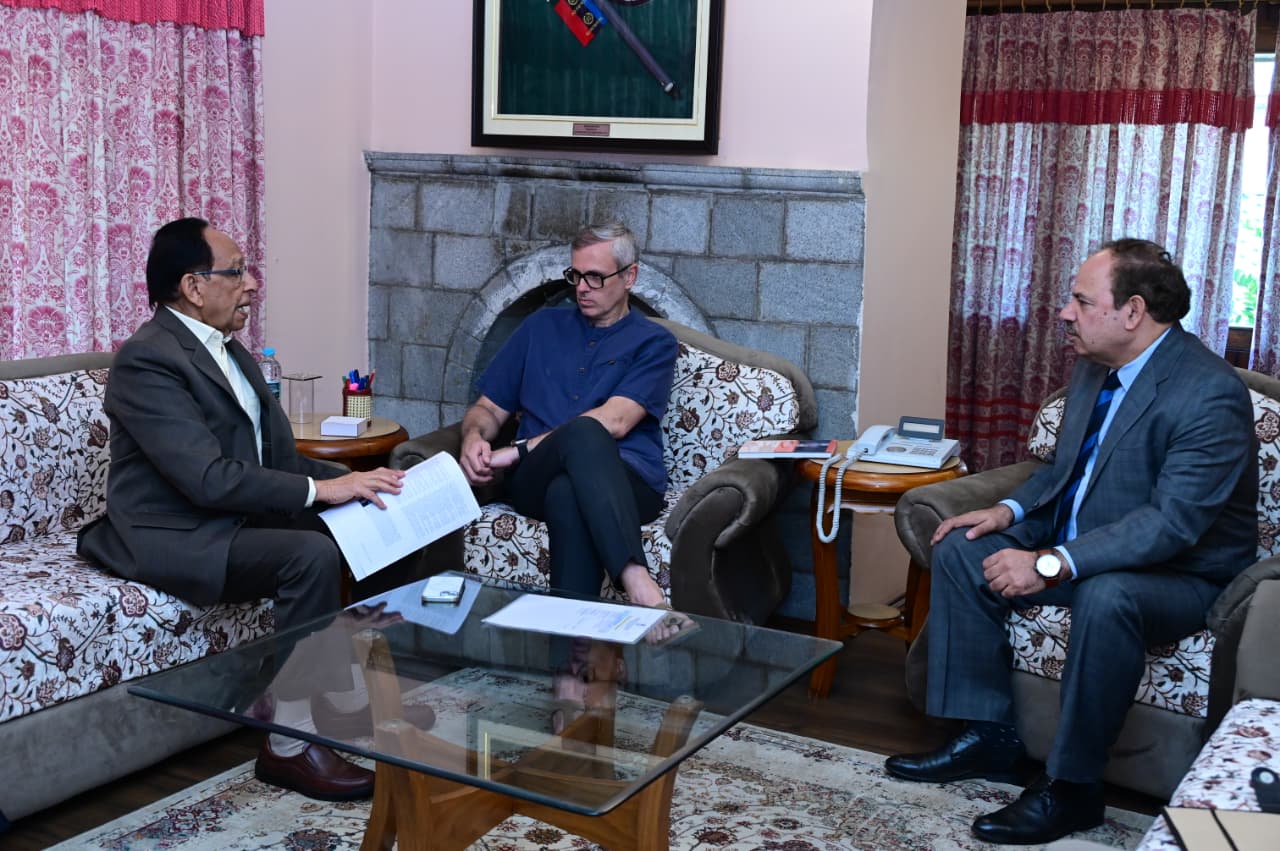
On September 24, Prof. Harsh K. Gupta, a distinguished earth scientist and former member of the National Disaster Management Authority (NDMA), met Chief Minister Omar Abdullah at the Public Outreach (Raabita) Office in Jammu. The meeting aimed to strengthen earthquake resilience and improve disaster preparedness strategies in Jammu and Kashmir, a region prone to seismic activities.
Chief Minister Omar Abdullah welcomed Prof. Gupta, with Advisor Nasir Aslam Wani and Prof. Shakil Ahmad Romshoo, Vice-Chancellor of the Islamic University of Science and Technology (IUST), also participating in the discussion.
Prof. Gupta highlighted the urgent necessity for the development of earthquake-resilient infrastructure in Kashmir. The region lies within the vulnerable Himalayan earthquake belt, susceptible to significant seismic events. His proposal emphasized the successful medium-term earthquake forecasting initiatives previously employed in the northeastern Himalayan region, advocating for similar efforts in Kashmir.
To bolster disaster preparedness, he recommended several strategies. He urged the government to observe an “Earthquake Safety Day,” aimed at educating the populace on seismic safety protocols. Training school students in earthquake safety emerged as a crucial aspect of his recommendations. Furthermore, Gupta proposed creating scenarios from past major earthquakes to enhance preparedness measures, alongside conducting large-scale mock drills.
Ensuring compliance with earthquake-safe construction practices is another critical element discussed. Prof. Gupta stressed implementing stringent regulations for building standards, considering the unique challenges posed by the region’s geology.
Additionally, he proposed the deployment of Earthquake Early Warning Systems across the Himalayan belt. These early warning systems can significantly reduce casualties and material loss during seismic events by providing critical alerts seconds before shaking begins.
In response, Chief Minister Omar Abdullah admitted the importance of Professor Gupta’s insights. He reiterated the government’s commitment to developing robust infrastructure capable of withstanding seismic activities. The Chief Minister confirmed that Prof. Gupta’s recommendations would be integrated into Jammu and Kashmir’s broader disaster preparedness strategy to ensure public safety efficiently.
As Jammu and Kashmir continues to face the repercussions of natural disasters, the collaboration between experts like Prof. Gupta and state officials highlights a proactive approach to safeguarding communities. Implementing earthquake-resilient measures will pave the way for a resilient future in a region known for its stunning landscapes yet vulnerable to seismic threats.