

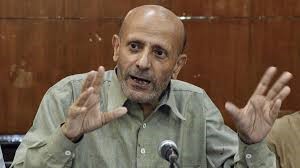
Sheikh Abdul Rashid, the jailed Lok Sabha MP from Baramulla, Jammu and Kashmir, will commence a two-day hunger strike from 10 am on October 1 to 10 am on October 3, coinciding with the eve of Gandhi Jayanti. His hunger strike aims to underscore the enduring relevance of Gandhi’s principles of non-violence and peace in today’s turbulent world.
Currently incarcerated in New Delhi’s Tihar jail on charges of terror funding, Rashid expressed in a handwritten letter addressed to Mahatma Gandhi, which was also sent to the Lok Sabha Speaker, the urgent need for peace across the globe. He asserted, “The whole world is in a desperate need for peace,” emphasizing the importance of non-violence.
Engineer Rashid, a prominent political figure, highlighted how his message resonates with Gandhi’s enduring legacy, stating that despite global claims of fighting for peace, nations still perpetuate violence. “Those who speak most of your message, Bapu, hardly match their words with deeds,” he remarked, drawing attention to the inconsistency between rhetoric and action.
In reflecting on the current state of Kashmir, Rashid expressed his disappointment, recalling that Gandhi viewed the region as a symbol of hope during the chaos of Partition. He lamented, “But as of now, we Kashmiris are being branded anti-national, Pak proxies, communal, and more. Being Islamist is an honour for every Muslim, and no true Muslim can ever be radical.”
Rashid’s poignant observations highlight the perception challenges faced by Kashmiris in contemporary India. He stressed that authorities fail to address the political and human rights issues plaguing Kashmir, arguing that, “Nobody is ready to address our snatched legitimate political and human rights.”
Underlining the dire situation, he noted that the ongoing turmoil stems from unresolved historical injustices, asserting, “Thousands lie in graves, and many in prisons lose their lives, victims of the consequences of Partition, for which nobody takes responsibility.”
Rashid also touched upon the plight of Kashmiri Pandits and border residents, recalling, “Kashmiri Pandits, who by your own confession were protected by Kashmiri Muslims at the cost of their own lives, are still living as refugees.” He described Tihar jail as a common ground for those advocates of non-violence, saying it has become a second home for many striving for their rights.
In condemning what he calls “divisive politics,” Rashid stated that Gandhi’s vision has been overshadowed by harsh governmental policies. “Our helplessness is being enjoyed by fascist forces, misleading the narrative that our commitment to non-violence is merely weakness,” he wrote. He further criticized the state for transforming Jammu and Kashmir into an experimental ground rather than addressing its historical grievances.
Rashid reminded readers of Gandhi’s teachings, expressing that, “I am sure your soul must be in a state of restlessness while watching what we Kashmiris are passing through since 1989.” He pointed out the detrimental labels placed upon Muslims, arguing that terms like ‘Babar ki Aulad’ (Children of Babar) only stoke societal hatred. He emphasized, “The state does not need enemies from outside; ultranationalists are doing their work better than any outside adversary could.”
The MP concluded his letter reaffirming the importance of Gandhi’s message and expressing his conviction that peaceful means must remain the cornerstone of the struggles for justice and equality. His hunger strike serves as a profound reminder of the urgent need to reflect on the principles of non-violence and unity in a fractious world.