

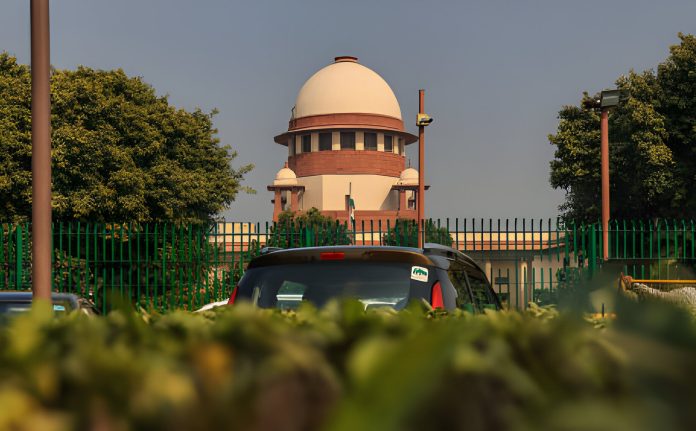
The Supreme Court of India on Wednesday referred the issue of anticipatory bail applications directly to high courts to a three-judge bench for examination of procedural norms. The bench, comprising Justices Vikram Nath and Sandeep Mehta, emphasized the necessity of hearing this matter through a larger bench once it is constituted.
In its deliberations, the apex court acknowledged the significance of the guidelines under which litigants navigate the bail process. Earlier, the court had appointed senior advocate Siddharth Luthra as an amicus curiae to assist in this matter.
On September 8, the Supreme Court raised concerns about the “regular practice” of the Kerala High Court to entertain anticipatory bail applications without litigants first approaching the sessions court. This practice has garnered scrutiny for potentially undermining judicial procedure.
The bench questioned, “One issue that is bothering us is that in the Kerala High Court, anticipatory bail applications are regularly entertained directly. Why is that so?” Such concerns underline the imperative for clarity regarding who may initiate bail applications and through which court.
The Supreme Court remarked that a clear hierarchy exists under the Criminal Procedure Code and the new Bharatiya Nagarik Suraksha Sanhita (BNSS), 2023, concerning bail applications. Section 482 of the BNSS delineates protocols for granting bail to individuals anticipating arrest.
The court noted, “It doesn’t happen in any other state. Only in the Kerala High Court… applications for anticipatory bail are regularly entertained directly,” suggesting that the established norms in other states are not being uniformly applied in Kerala.
The discussion stemmed from a plea filed by two individuals contesting a prior order of the Kerala High Court, which denied them anticipatory bail. The petitioners had approached the high court without seeking relief from the sessions court first, bringing the unusual practice into question.
While scrutinizing this case, the Supreme Court indicated concerns that this practice could deprive the courts of comprehensive factual records typically provided before a sessions court. The bench stated, “We are inclined to consider whether the option to approach the high court is a matter of choice for the accused or whether it should be mandatory to first go to the sessions court.”
In a notable step, the top court also issued a notice to the Kerala High Court, requesting a formal response through its Registrar General on the procedure followed regarding anticipatory bail requests. This step emphasizes the Supreme Court’s commitment to addressing procedural anomalies within the judicial system.
The anticipation now rests on the eventual hearing by the three-judge bench as it aims to clarify these legal ambiguities in the context of anticipatory bail applications. This could lead to significant shifts in how such requests are handled across the country, ensuring a consistent approach in administration of justice.